'%3e%3crect%20x='2'%20y='1.64014'%20width='48'%20height='48'%20rx='24'%20fill='%23292929'/%3e%3crect%20x='2.625'%20y='2.26514'%20width='46.75'%20height='46.75'%20rx='23.375'%20stroke='%23636363'%20stroke-width='1.25'/%3e%3cpath%20d='M22.6665%2025.6402L24.8887%2027.8624L29.8887%2022.8624M20.8151%2016.5498C21.7082%2016.4786%2022.5561%2016.1273%2023.2381%2015.5462C24.8295%2014.19%2027.1701%2014.19%2028.7615%2015.5462C29.4434%2016.1273%2030.2913%2016.4786%2031.1845%2016.5498C33.2687%2016.7162%2034.9238%2018.3712%2035.0901%2020.4555C35.1614%2021.3486%2035.5126%2022.1965%2036.0938%2022.8785C37.4499%2024.4699%2037.4499%2026.8105%2036.0938%2028.4019C35.5126%2029.0838%2035.1614%2029.9317%2035.0901%2030.8249C34.9238%2032.9091%2033.2687%2034.5642%2031.1845%2034.7305C30.2913%2034.8018%2029.4434%2035.153%2028.7615%2035.7341C27.1701%2037.0903%2024.8295%2037.0903%2023.2381%2035.7341C22.5561%2035.153%2021.7082%2034.8018%2020.8151%2034.7305C18.7308%2034.5642%2017.0758%2032.9091%2016.9094%2030.8249C16.8382%2029.9317%2016.487%2029.0838%2015.9058%2028.4019C14.5496%2026.8105%2014.5496%2024.4699%2015.9058%2022.8785C16.487%2022.1965%2016.8382%2021.3486%2016.9094%2020.4555C17.0758%2018.3712%2018.7308%2016.7161%2020.8151%2016.5498Z'%20stroke='%23E7E7E7'%20stroke-width='1.125'%20stroke-linecap='round'%20stroke-linejoin='round'/%3e%3c/g%3e%3cdefs%3e%3cfilter%20id='filter0_d_411_10857'%20x='0.5'%20y='0.140137'%20width='51'%20height='51'%20filterUnits='userSpaceOnUse'%20color-interpolation-filters='sRGB'%3e%3cfeFlood%20flood-opacity='0'%20result='BackgroundImageFix'/%3e%3cfeColorMatrix%20in='SourceAlpha'%20type='matrix'%20values='0%200%200%200%200%200%200%200%200%200%200%200%200%200%200%200%200%200%20127%200'%20result='hardAlpha'/%3e%3cfeMorphology%20radius='1.5'%20operator='dilate'%20in='SourceAlpha'%20result='effect1_dropShadow_411_10857'/%3e%3cfeOffset/%3e%3cfeComposite%20in2='hardAlpha'%20operator='out'/%3e%3cfeColorMatrix%20type='matrix'%20values='0%200%200%200%200.08%200%200%200%200%200.08%200%200%200%200%200.08%200%200%200%201%200'/%3e%3cfeBlend%20mode='normal'%20in2='BackgroundImageFix'%20result='effect1_dropShadow_411_10857'/%3e%3cfeBlend%20mode='normal'%20in='SourceGraphic'%20in2='effect1_dropShadow_411_10857'%20result='shape'/%3e%3c/filter%3e%3c/defs%3e%3c/svg%3e)
'%3e%3crect%20x='2'%20y='1.64014'%20width='48'%20height='48'%20rx='24'%20fill='%23292929'/%3e%3crect%20x='2.625'%20y='2.26514'%20width='46.75'%20height='46.75'%20rx='23.375'%20stroke='%23636363'%20stroke-width='1.25'/%3e%3cpath%20d='M21.5556%2015.6401H19.5556C18.311%2015.6401%2017.6887%2015.6401%2017.2134%2015.8823C16.7952%2016.0954%2016.4553%2016.4354%2016.2422%2016.8535C16%2017.3289%2016%2017.9511%2016%2019.1957V21.1957M21.5556%2035.6401H19.5556C18.311%2035.6401%2017.6887%2035.6401%2017.2134%2035.3979C16.7952%2035.1849%2016.4553%2034.8449%2016.2422%2034.4268C16%2033.9514%2016%2033.3291%2016%2032.0846V30.0846M36%2021.1957V19.1957C36%2017.9511%2036%2017.3289%2035.7578%2016.8535C35.5447%2016.4354%2035.2048%2016.0954%2034.7866%2015.8823C34.3113%2015.6401%2033.689%2015.6401%2032.4444%2015.6401H30.4444M36%2030.0846V32.0846C36%2033.3291%2036%2033.9514%2035.7578%2034.4268C35.5447%2034.8449%2035.2048%2035.1849%2034.7866%2035.3979C34.3113%2035.6401%2033.689%2035.6401%2032.4444%2035.6401H30.4444M30.4444%2025.6401C30.4444%2028.0947%2028.4546%2030.0846%2026%2030.0846C23.5454%2030.0846%2021.5556%2028.0947%2021.5556%2025.6401C21.5556%2023.1855%2023.5454%2021.1957%2026%2021.1957C28.4546%2021.1957%2030.4444%2023.1855%2030.4444%2025.6401Z'%20stroke='%23E7E7E7'%20stroke-width='1.125'%20stroke-linecap='round'%20stroke-linejoin='round'/%3e%3c/g%3e%3cdefs%3e%3cfilter%20id='filter0_d_1154_2040'%20x='0.5'%20y='0.140137'%20width='51'%20height='51'%20filterUnits='userSpaceOnUse'%20color-interpolation-filters='sRGB'%3e%3cfeFlood%20flood-opacity='0'%20result='BackgroundImageFix'/%3e%3cfeColorMatrix%20in='SourceAlpha'%20type='matrix'%20values='0%200%200%200%200%200%200%200%200%200%200%200%200%200%200%200%200%200%20127%200'%20result='hardAlpha'/%3e%3cfeMorphology%20radius='1.5'%20operator='dilate'%20in='SourceAlpha'%20result='effect1_dropShadow_1154_2040'/%3e%3cfeOffset/%3e%3cfeComposite%20in2='hardAlpha'%20operator='out'/%3e%3cfeColorMatrix%20type='matrix'%20values='0%200%200%200%200.08%200%200%200%200%200.08%200%200%200%200%200.08%200%200%200%201%200'/%3e%3cfeBlend%20mode='normal'%20in2='BackgroundImageFix'%20result='effect1_dropShadow_1154_2040'/%3e%3cfeBlend%20mode='normal'%20in='SourceGraphic'%20in2='effect1_dropShadow_1154_2040'%20result='shape'/%3e%3c/filter%3e%3c/defs%3e%3c/svg%3e)
'%3e%3crect%20x='2'%20y='1.64014'%20width='48'%20height='48'%20rx='24'%20fill='%23292929'/%3e%3crect%20x='2.625'%20y='2.26514'%20width='46.75'%20height='46.75'%20rx='23.375'%20stroke='%23636363'%20stroke-width='1.25'/%3e%3cpath%20d='M23.7778%2031.9275V34.5291C23.7778%2035.7564%2024.7727%2036.7513%2026%2036.7513C27.2273%2036.7513%2028.2222%2035.7564%2028.2222%2034.5291V31.9275M26%2014.5291V15.6402M16%2025.6402H14.8889M18.7778%2018.4179L18.111%2017.7512M33.2222%2018.4179L33.8892%2017.7512M37.1111%2025.6402H36M32.6667%2025.6402C32.6667%2029.3221%2029.6819%2032.3068%2026%2032.3068C22.3181%2032.3068%2019.3333%2029.3221%2019.3333%2025.6402C19.3333%2021.9583%2022.3181%2018.9735%2026%2018.9735C29.6819%2018.9735%2032.6667%2021.9583%2032.6667%2025.6402Z'%20stroke='%23E7E7E7'%20stroke-width='1.125'%20stroke-linecap='round'%20stroke-linejoin='round'/%3e%3c/g%3e%3cdefs%3e%3cfilter%20id='filter0_d_1117_17437'%20x='0.5'%20y='0.140137'%20width='51'%20height='51'%20filterUnits='userSpaceOnUse'%20color-interpolation-filters='sRGB'%3e%3cfeFlood%20flood-opacity='0'%20result='BackgroundImageFix'/%3e%3cfeColorMatrix%20in='SourceAlpha'%20type='matrix'%20values='0%200%200%200%200%200%200%200%200%200%200%200%200%200%200%200%200%200%20127%200'%20result='hardAlpha'/%3e%3cfeMorphology%20radius='1.5'%20operator='dilate'%20in='SourceAlpha'%20result='effect1_dropShadow_1117_17437'/%3e%3cfeOffset/%3e%3cfeComposite%20in2='hardAlpha'%20operator='out'/%3e%3cfeColorMatrix%20type='matrix'%20values='0%200%200%200%200.08%200%200%200%200%200.08%200%200%200%200%200.08%200%200%200%201%200'/%3e%3cfeBlend%20mode='normal'%20in2='BackgroundImageFix'%20result='effect1_dropShadow_1117_17437'/%3e%3cfeBlend%20mode='normal'%20in='SourceGraphic'%20in2='effect1_dropShadow_1117_17437'%20result='shape'/%3e%3c/filter%3e%3c/defs%3e%3c/svg%3e)
'%3e%3crect%20x='2.33301'%20y='2'%20width='48'%20height='48'%20rx='24'%20fill='%23292929'/%3e%3crect%20x='2.95801'%20y='2.625'%20width='46.75'%20height='46.75'%20rx='23.375'%20stroke='%23636363'%20stroke-width='1.25'/%3e%3cpath%20d='M18.5557%2022.6665H34.1112M18.5557%2029.3332H34.1112'%20stroke='%23E7E7E7'%20stroke-width='1.125'%20stroke-linecap='round'%20stroke-linejoin='round'/%3e%3c/g%3e%3cdefs%3e%3cfilter%20id='filter0_d_1851_59239'%20x='0.833008'%20y='0.5'%20width='51'%20height='51'%20filterUnits='userSpaceOnUse'%20color-interpolation-filters='sRGB'%3e%3cfeFlood%20flood-opacity='0'%20result='BackgroundImageFix'/%3e%3cfeColorMatrix%20in='SourceAlpha'%20type='matrix'%20values='0%200%200%200%200%200%200%200%200%200%200%200%200%200%200%200%200%200%20127%200'%20result='hardAlpha'/%3e%3cfeMorphology%20radius='1.5'%20operator='dilate'%20in='SourceAlpha'%20result='effect1_dropShadow_1851_59239'/%3e%3cfeOffset/%3e%3cfeComposite%20in2='hardAlpha'%20operator='out'/%3e%3cfeColorMatrix%20type='matrix'%20values='0%200%200%200%200.08%200%200%200%200%200.08%200%200%200%200%200.08%200%200%200%201%200'/%3e%3cfeBlend%20mode='normal'%20in2='BackgroundImageFix'%20result='effect1_dropShadow_1851_59239'/%3e%3cfeBlend%20mode='normal'%20in='SourceGraphic'%20in2='effect1_dropShadow_1851_59239'%20result='shape'/%3e%3c/filter%3e%3c/defs%3e%3c/svg%3e)
'%3e%3crect%20x='2'%20y='2.14014'%20width='48'%20height='48'%20rx='24'%20fill='%23292929'/%3e%3crect%20x='2.625'%20y='2.76514'%20width='46.75'%20height='46.75'%20rx='23.375'%20stroke='%23636363'%20stroke-width='1.25'/%3e%3cpath%20d='M22.6667%2015.0288V17.251M29.3333%2015.0288V17.251M22.6667%2035.0288V37.251M29.3333%2035.0288V37.251M34.8889%2022.8066H37.1111M34.8889%2028.3621H37.1111M14.8889%2022.8066H17.1111M14.8889%2028.3621H17.1111M22.4444%2035.0288H29.5556C31.4224%2035.0288%2032.3558%2035.0288%2033.0689%2034.6655C33.6961%2034.3459%2034.206%2033.836%2034.5256%2033.2088C34.8889%2032.4957%2034.8889%2031.5623%2034.8889%2029.6955V22.5844C34.8889%2020.7175%2034.8889%2019.7841%2034.5256%2019.0711C34.206%2018.4439%2033.6961%2017.9339%2033.0689%2017.6143C32.3558%2017.251%2031.4224%2017.251%2029.5556%2017.251H22.4444C20.5776%2017.251%2019.6442%2017.251%2018.9311%2017.6143C18.3039%2017.9339%2017.794%2018.4439%2017.4744%2019.0711C17.1111%2019.7841%2017.1111%2020.7175%2017.1111%2022.5844V29.6955C17.1111%2031.5623%2017.1111%2032.4957%2017.4744%2033.2088C17.794%2033.836%2018.3039%2034.3459%2018.9311%2034.6655C19.6442%2035.0288%2020.5776%2035.0288%2022.4444%2035.0288ZM24.4444%2029.4733H27.5556C28.1778%2029.4733%2028.489%2029.4733%2028.7267%2029.3522C28.9357%2029.2456%2029.1057%2029.0756%2029.2122%2028.8666C29.3333%2028.6289%2029.3333%2028.3178%2029.3333%2027.6955V24.5844C29.3333%2023.9621%2029.3333%2023.6509%2029.2122%2023.4133C29.1057%2023.2042%2028.9357%2023.0342%2028.7267%2022.9277C28.489%2022.8066%2028.1778%2022.8066%2027.5556%2022.8066H24.4444C23.8222%2022.8066%2023.511%2022.8066%2023.2733%2022.9277C23.0643%2023.0342%2022.8943%2023.2042%2022.7878%2023.4133C22.6667%2023.6509%2022.6667%2023.9621%2022.6667%2024.5844V27.6955C22.6667%2028.3178%2022.6667%2028.6289%2022.7878%2028.8666C22.8943%2029.0756%2023.0643%2029.2456%2023.2733%2029.3522C23.511%2029.4733%2023.8222%2029.4733%2024.4444%2029.4733Z'%20stroke='%23E7E7E7'%20stroke-width='1.125'%20stroke-linecap='round'%20stroke-linejoin='round'/%3e%3c/g%3e%3cdefs%3e%3cfilter%20id='filter0_d_1117_10655'%20x='0.5'%20y='0.640137'%20width='51'%20height='51'%20filterUnits='userSpaceOnUse'%20color-interpolation-filters='sRGB'%3e%3cfeFlood%20flood-opacity='0'%20result='BackgroundImageFix'/%3e%3cfeColorMatrix%20in='SourceAlpha'%20type='matrix'%20values='0%200%200%200%200%200%200%200%200%200%200%200%200%200%200%200%200%200%20127%200'%20result='hardAlpha'/%3e%3cfeMorphology%20radius='1.5'%20operator='dilate'%20in='SourceAlpha'%20result='effect1_dropShadow_1117_10655'/%3e%3cfeOffset/%3e%3cfeComposite%20in2='hardAlpha'%20operator='out'/%3e%3cfeColorMatrix%20type='matrix'%20values='0%200%200%200%200.08%200%200%200%200%200.08%200%200%200%200%200.08%200%200%200%201%200'/%3e%3cfeBlend%20mode='normal'%20in2='BackgroundImageFix'%20result='effect1_dropShadow_1117_10655'/%3e%3cfeBlend%20mode='normal'%20in='SourceGraphic'%20in2='effect1_dropShadow_1117_10655'%20result='shape'/%3e%3c/filter%3e%3c/defs%3e%3c/svg%3e)

'%3e%3crect%20x='1.66699'%20y='2'%20width='48'%20height='48'%20rx='24'%20fill='%23292929'/%3e%3crect%20x='2.29199'%20y='2.625'%20width='46.75'%20height='46.75'%20rx='23.375'%20stroke='%23636363'%20stroke-width='1.25'/%3e%3cpath%20d='M35.667%2032.6667L34.5557%2033.8823C33.9664%2034.5269%2033.1672%2034.8889%2032.3338%2034.8889C31.5004%2034.8889%2030.7012%2034.5269%2030.1119%2033.8823C29.5217%2033.2391%2028.7225%2032.8779%2027.8894%2032.8779C27.0563%2032.8779%2026.2571%2033.2391%2025.667%2033.8823M15.667%2034.8889H17.5276C18.0711%2034.8889%2018.3429%2034.8889%2018.5986%2034.8275C18.8254%2034.7731%2019.0422%2034.6833%2019.241%2034.5615C19.4652%2034.424%2019.6574%2034.2319%2020.0418%2033.8475L34.0004%2019.8889C34.9208%2018.9684%2034.9208%2017.4761%2034.0004%2016.5556C33.0799%2015.6351%2031.5875%2015.6351%2030.667%2016.5556L16.7084%2030.5142C16.3241%2030.8985%2016.1319%2031.0907%2015.9945%2031.315C15.8726%2031.5138%2015.7828%2031.7306%2015.7284%2031.9573C15.667%2032.213%2015.667%2032.4848%2015.667%2033.0284V34.8889Z'%20stroke='%23E7E7E7'%20stroke-width='1.125'%20stroke-linecap='round'%20stroke-linejoin='round'/%3e%3c/g%3e%3cdefs%3e%3cfilter%20id='filter0_d_1851_59244'%20x='0.166992'%20y='0.5'%20width='51'%20height='51'%20filterUnits='userSpaceOnUse'%20color-interpolation-filters='sRGB'%3e%3cfeFlood%20flood-opacity='0'%20result='BackgroundImageFix'/%3e%3cfeColorMatrix%20in='SourceAlpha'%20type='matrix'%20values='0%200%200%200%200%200%200%200%200%200%200%200%200%200%200%200%200%200%20127%200'%20result='hardAlpha'/%3e%3cfeMorphology%20radius='1.5'%20operator='dilate'%20in='SourceAlpha'%20result='effect1_dropShadow_1851_59244'/%3e%3cfeOffset/%3e%3cfeComposite%20in2='hardAlpha'%20operator='out'/%3e%3cfeColorMatrix%20type='matrix'%20values='0%200%200%200%200.08%200%200%200%200%200.08%200%200%200%200%200.08%200%200%200%201%200'/%3e%3cfeBlend%20mode='normal'%20in2='BackgroundImageFix'%20result='effect1_dropShadow_1851_59244'/%3e%3cfeBlend%20mode='normal'%20in='SourceGraphic'%20in2='effect1_dropShadow_1851_59244'%20result='shape'/%3e%3c/filter%3e%3c/defs%3e%3c/svg%3e)
'%3e%3crect%20x='2'%20y='1.64014'%20width='48'%20height='48'%20rx='24'%20fill='%23292929'/%3e%3crect%20x='2.625'%20y='2.26514'%20width='46.75'%20height='46.75'%20rx='23.375'%20stroke='%23636363'%20stroke-width='1.25'/%3e%3cpath%20d='M25.9998%2035.6401L25.8886%2035.4734C25.1168%2034.3156%2024.7309%2033.7368%2024.221%2033.3177C23.7696%2032.9467%2023.2495%2032.6684%2022.6905%2032.4986C22.059%2032.3068%2021.3632%2032.3068%2019.9718%2032.3068H18.4442C17.1997%2032.3068%2016.5774%2032.3068%2016.102%2032.0646C15.6839%2031.8515%2015.3439%2031.5116%2015.1309%2031.0934C14.8887%2030.6181%2014.8887%2029.9958%2014.8887%2028.7512V19.1957C14.8887%2017.9511%2014.8887%2017.3289%2015.1309%2016.8535C15.3439%2016.4354%2015.6839%2016.0954%2016.102%2015.8823C16.5774%2015.6401%2017.1997%2015.6401%2018.4442%2015.6401H18.8887C21.3778%2015.6401%2022.6224%2015.6401%2023.5731%2016.1246C24.4094%2016.5507%2025.0893%2017.2306%2025.5154%2018.0668C25.9998%2019.0176%2025.9998%2020.2621%2025.9998%2022.7512M25.9998%2035.6401V22.7512M25.9998%2035.6401L26.111%2035.4734C26.8828%2034.3156%2027.2687%2033.7368%2027.7786%2033.3177C28.2299%2032.9467%2028.75%2032.6684%2029.3091%2032.4986C29.9406%2032.3068%2030.6363%2032.3068%2032.0278%2032.3068H33.5553C34.7999%2032.3068%2035.4222%2032.3068%2035.8975%2032.0646C36.3157%2031.8515%2036.6556%2031.5116%2036.8687%2031.0934C37.1109%2030.6181%2037.1109%2029.9958%2037.1109%2028.7512V19.1957C37.1109%2017.9511%2037.1109%2017.3289%2036.8687%2016.8535C36.6556%2016.4354%2036.3157%2016.0954%2035.8975%2015.8823C35.4222%2015.6401%2034.7999%2015.6401%2033.5553%2015.6401H33.1109C30.6218%2015.6401%2029.3772%2015.6401%2028.4265%2016.1246C27.5902%2016.5507%2026.9103%2017.2306%2026.4842%2018.0668C25.9998%2019.0176%2025.9998%2020.2621%2025.9998%2022.7512'%20stroke='%23E7E7E7'%20stroke-width='1.125'%20stroke-linecap='round'%20stroke-linejoin='round'/%3e%3c/g%3e%3cdefs%3e%3cfilter%20id='filter0_d_1154_3945'%20x='0.5'%20y='0.140137'%20width='51'%20height='51'%20filterUnits='userSpaceOnUse'%20color-interpolation-filters='sRGB'%3e%3cfeFlood%20flood-opacity='0'%20result='BackgroundImageFix'/%3e%3cfeColorMatrix%20in='SourceAlpha'%20type='matrix'%20values='0%200%200%200%200%200%200%200%200%200%200%200%200%200%200%200%200%200%20127%200'%20result='hardAlpha'/%3e%3cfeMorphology%20radius='1.5'%20operator='dilate'%20in='SourceAlpha'%20result='effect1_dropShadow_1154_3945'/%3e%3cfeOffset/%3e%3cfeComposite%20in2='hardAlpha'%20operator='out'/%3e%3cfeColorMatrix%20type='matrix'%20values='0%200%200%200%200.08%200%200%200%200%200.08%200%200%200%200%200.08%200%200%200%201%200'/%3e%3cfeBlend%20mode='normal'%20in2='BackgroundImageFix'%20result='effect1_dropShadow_1154_3945'/%3e%3cfeBlend%20mode='normal'%20in='SourceGraphic'%20in2='effect1_dropShadow_1154_3945'%20result='shape'/%3e%3c/filter%3e%3c/defs%3e%3c/svg%3e)
Mar 10, 2026
ChatGPT Enterprise Pricing 2026: Cost, Plans & What You Get
Inference Research
ChatGPT Enterprise Pricing at a Glance (2026)
ChatGPT Enterprise pricing starts at approximately $60 per user per month, but OpenAI doesn't publish a sticker price — every contract is negotiated directly with their sales team. With a 150-seat minimum and a mandatory annual commitment, the floor for an Enterprise deployment is roughly $108,000 per year. That number can move considerably depending on seat count, contract length, and how prepared your procurement team is going in.
2026 has reshuffled the product lineup in ways that matter for buyers. GPT-4o, which powered most ChatGPT plans through 2025, was retired in February 2026. GPT-5.4 is now the engine behind ChatGPT Enterprise, bringing substantially better reasoning, longer effective context, and stronger multimodal capabilities. OpenAI also added a new Go plan — positioned between Team and Enterprise for companies that aren't ready for the 150-seat floor — and launched the OpenAI Frontier agentic platform as a separate high-end tier above Enterprise. Any pricing research you did in 2025 needs to be revisited.
The sections below cover the full 2026 pricing breakdown, a plan-by-plan comparison across the entire ChatGPT lineup, an Enterprise vs. Team decision framework, the specific negotiation levers that move the contract price, nonprofit and education discounts that OpenAI doesn't prominently advertise, and a realistic total cost of ownership model for a 200-seat deployment.
ChatGPT Enterprise does not have a listed price. OpenAI operates through direct enterprise sales, and the per-seat rate is negotiated based on seat count, usage commitments, and contract term. The widely reported figure — approximately $60 per user per month — reflects deal data, buyer disclosures, and procurement community research. In practice, contracts range from roughly $45 to $75 per user per month, with the lower end available to larger deployments and multi-year commitments.
Two requirements are non-negotiable: a 150-seat minimum and an annual contract. There is no month-to-month option for Enterprise; OpenAI requires a full-year commitment, billed as a prepaid annual invoice. At 150 seats and $60/user, that puts minimum annual spend at $108,000. At 500 seats and a negotiated $50/user rate, you're looking at $300,000 per year.
The 2026 ChatGPT Plan Ladder
Enterprise sits near the top of a seven-tier product lineup that changed significantly in early 2026. Here's where it fits:
| Plan | Price | Min. Seats | Billing | GPT-5.4 Access | Key Differentiator |
|---|---|---|---|---|---|
| Free | $0 | 1 | N/A | Limited (rate-capped) | Basic access, no cost |
| Plus | $20/user/mo | 1 | Monthly | Standard | Expanded limits, DALL-E 3, voice mode |
| Pro | $200/user/mo | 1 | Monthly | Unlimited + o1 Pro | Highest personal usage ceiling |
| Go | ~$35–40/user/mo | 10 | Annual | Standard | Enterprise-grade privacy + SSO, no 150-seat floor |
| Team | $25/user/mo | 2 | Monthly or annual | Rate-limited | Shared workspace, admin console, no training on data |
| Enterprise | ~$60/user/mo | 150 | Annual (prepaid) | Priority + uncapped | SOC 2, HIPAA BAA, audit logs, org-wide GPT deploy |
| Frontier | Custom | Custom | Annual | Priority + dedicated | Autonomous AI agents, custom deployment at scale |
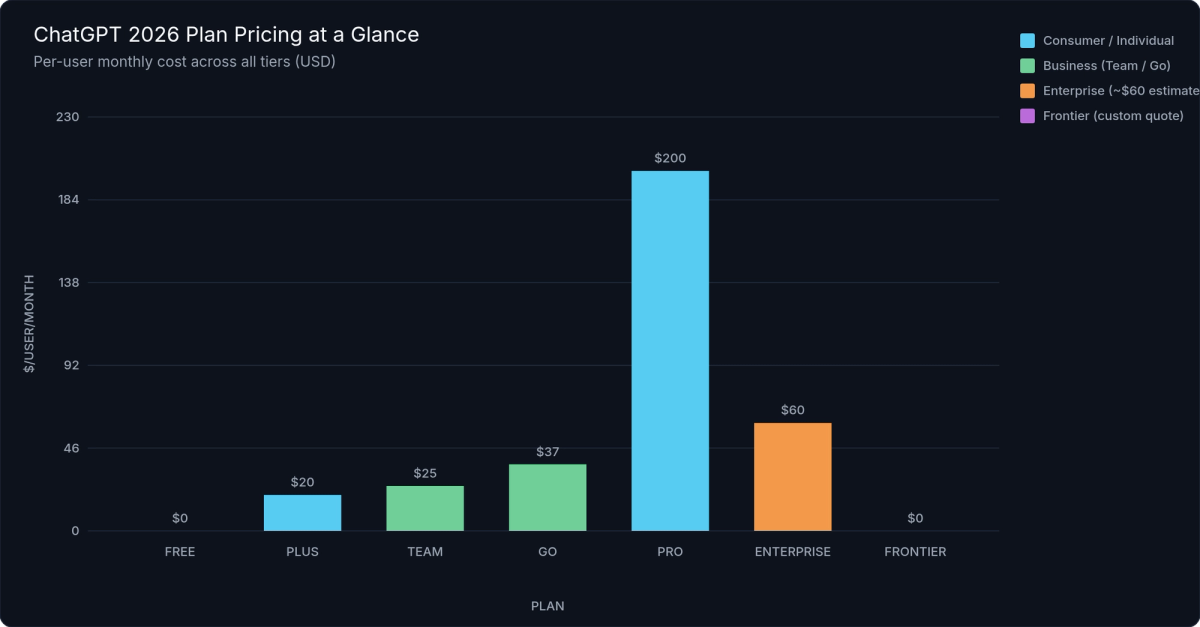
Figure 1: ChatGPT Plan Pricing Comparison (2026) — Estimated monthly cost per user across all ChatGPT tiers
The plan ladder runs from Free (no cost, limited GPT-5.4 access) up through Plus ($20/month), Pro ($200/month for power users), Go (~$35–40/user/month, new in 2026), Team ($25/user/month annual), Enterprise (~$60/user/month, custom quote), and finally Frontier (custom pricing, OpenAI's dedicated agentic AI platform).
The most important addition for enterprise buyers is the Go plan. It fills the long-standing gap for companies with 10–149 users who need enterprise-grade privacy and SSO but can't justify the 150-seat Enterprise minimum. If your team falls into that range, evaluate Go before defaulting to Team or jumping straight to Enterprise.
At the other end, OpenAI Frontier is not a ChatGPT interface product — it's a separate platform for companies deploying autonomous AI agents at scale. Worth knowing about if you're doing a thorough market survey, but if you're evaluating ChatGPT Enterprise as a workforce productivity tool, Frontier is a different conversation entirely.
Read time: 10 minutes
---
What's New in 2026: GPT-5.4, the Go Plan, and OpenAI Frontier
If you researched ChatGPT Enterprise pricing in 2025, several foundational assumptions have changed. Here's the 2026 delta that matters for procurement.
GPT-4o Retirement (February 2026)
GPT-4o was OpenAI's flagship model powering ChatGPT Enterprise and most other tiers through 2025. It was formally retired in February 2026. Enterprise customers on GPT-4o have been migrated to GPT-5.4 or other GPT-5-series models. Any vendor comparison, benchmarking study, or pricing analysis that references GPT-4o as the Enterprise model is now out of date. If you received a vendor quote or read a competitor's "2025 pricing guide," the model tier has changed.
GPT-5.4: The New Enterprise Engine (March 2026)
GPT-5.4 is the current flagship model powering ChatGPT Enterprise as of March 2026. Compared to GPT-4o, it delivers better multi-step reasoning, improved instruction following on complex tasks, stronger performance on code and document analysis, and an effectively longer usable context window. For Enterprise customers, this is an upgrade at the same contract price — a more capable model than what was included in 2025 contracts. Enterprise and higher-tier users receive priority access to GPT-5.4; Team and lower-tier users access the same model but with rate limits and potentially truncated context. For more on GPT-5.4 performance benchmarks, see GPT-5.4 model benchmarks.
The Go Plan: Filling the 10–149 Seat Gap
One of the most practically useful additions to the lineup in 2026 is the Go plan. It's designed for companies in the 10–149 user range that need more than Team — specifically, enterprise-grade privacy guarantees and SSO support — but can't meet or don't want the 150-seat Enterprise floor. Pricing is estimated at ~$35–40 per user per month, putting it clearly between Team ($25) and Enterprise (~$60). Go includes most Enterprise-level privacy protections but comes with fewer admin controls and no dedicated Customer Success Manager. For growing mid-market teams, it's an upgrade path that simply didn't exist before 2026.
OpenAI Frontier: The Agentic Layer Above Enterprise
OpenAI Frontier, launched in February 2026, is a distinct platform from ChatGPT Enterprise. Where Enterprise is a workforce productivity product built around a chat interface, Frontier is designed for companies deploying autonomous AI agents — systems that take multi-step actions, coordinate multiple models, and operate with minimal human intervention at scale. Pricing is custom and higher than Enterprise. Frontier is not a replacement for Enterprise; it's additive. Most organizations evaluating ChatGPT Enterprise for knowledge worker productivity will not need Frontier. It's aimed at AI-native companies and engineering-heavy organizations building agent-based workflows.
---
ChatGPT Enterprise Features: What You Actually Get
The ~$60/user/month price tag needs to be justified against what Enterprise actually delivers versus cheaper alternatives. Below is a breakdown across the five capability areas that matter most for enterprise procurement.
Security and Compliance
ChatGPT Enterprise is SOC 2 Type II certified, meaning OpenAI's security controls have been independently audited and validated. For regulated industries, the most significant compliance feature is the HIPAA Business Associate Agreement (BAA) — Enterprise is one of the few ChatGPT tiers eligible for HIPAA coverage, making it viable for healthcare organizations, insurance companies, and legal services firms handling protected health information. The BAA must be explicitly requested and executed during the contract process.
On the infrastructure side, data is encrypted at rest (AES-256) and in transit (TLS 1.2+). User authentication integrates with enterprise identity providers via SAML 2.0 Single Sign-On — including Okta, Azure Active Directory, Google Workspace, and most major IAM platforms. SCIM provisioning is also included, enabling automated user lifecycle management (automatic deprovisioning when employees leave, for example). Workspace isolation and domain verification ensure your organization's environment is separated from other Enterprise tenants.
Data Privacy Guarantees
The data privacy posture is the feature most IT and legal teams care about first. On Enterprise, your data is not used to train OpenAI models — this is the default, not an opt-out you have to hunt for. The zero-training guarantee is contractually included in all Enterprise agreements. Conversation data is stored within your tenant only and is not accessible to OpenAI for model improvement purposes.
For organizations operating in regulated jurisdictions, data residency options (US and EU) are available on Enterprise contracts. Audit logs covering all user activity are included as a standard feature — these are essential for compliance teams, legal hold requirements, and internal security monitoring. If your organization has ever struggled to reconstruct what was done with AI tools during an incident review, the audit log capability alone can justify the Enterprise tier.
Model Access and Usage
Enterprise customers get access to all current frontier models, including GPT-5.4 as of March 2026. There are also no usage caps per user. This is a real distinction: ChatGPT Plus has message rate limits, and the Team plan has soft caps that can slow power users. Enterprise removes those constraints — users can run as many sessions and generate as many tokens as their work requires. For high-throughput roles like analysts, researchers, and engineers, uncapped usage makes a practical difference day to day.
Enterprise users also get the full context window of each model. Lower-tier users sometimes get truncated context even on the same model. Additionally, Enterprise customers receive priority and early access to new model releases, typically 2–4 weeks ahead of general availability. For organizations where AI capability is a competitive factor, that lead time matters.
Admin and Management
The administrative control layer is where Enterprise separates itself most clearly from Team and below. A centralized admin console handles user provisioning, permission management, and usage reporting. The usage analytics dashboard provides department-level breakdowns of activity — who is using which features, how frequently, and at what volume. This matters when you need to demonstrate adoption ROI to leadership.
Admins can deploy custom GPTs organization-wide — a capability that doesn't exist on Team, where GPTs are per-user rather than centrally managed. Your organization can build tailored assistants for legal review, customer support, HR policy, or sales enablement and push them to all users through the admin console. Policy controls let admins disable specific features (image generation, web browsing, voice mode) for specific user groups, supporting compliance and governance requirements. Enterprise accounts above threshold seat counts also receive a dedicated Customer Success Manager for onboarding, training, and ongoing support.
Enterprise Integrations
API access is included with Enterprise contracts — typically with bundled API credits or discounted API rates negotiated as part of the deal. This matters for teams building internal tools on top of the ChatGPT interface. Microsoft 365 ecosystem integration was expanded in early 2026, enabling deeper embedding of ChatGPT capabilities within familiar productivity tools. Shared GPT workspaces support collaborative work on shared AI assistants across teams. Advanced Data Analysis (previously Code Interpreter) is available with enterprise-grade file storage, supporting large-file data analysis workflows that hit limits on lower tiers. For guidance on getting the most from the API side of your Enterprise contract, see how to use the OpenAI API.
---
ChatGPT Enterprise vs. Team: When to Upgrade
If you have 150 or more seats, the question usually isn't whether Enterprise is better than Team — it almost certainly is. The real question is whether the delta justifies spending roughly $35 more per user per month. At 150 seats, that's an additional $63,000 per year. Here's a framework for making that call.
Team Plan Quick Facts
The Team plan is priced at $25/user/month on annual billing ($30/month on monthly billing), with a two-seat minimum. It includes shared workspace, an admin console, 100K context window access, and GPT-5.4 access (rate-limited). What Team does not include: SSO/SAML, SCIM provisioning, HIPAA BAA eligibility, audit logs, data residency, dedicated support, or org-wide custom GPT deployment. Team conversations are also protected from training use — worth noting, since this isn't exclusive to Enterprise.
| Feature | Team | Enterprise |
|---|---|---|
| Price | $25/user/mo (annual) · $30 (monthly) | ~$60/user/mo (custom quote) |
| Minimum seats | 2 | 150 |
| Billing options | Monthly or annual | Annual only (prepaid) |
| GPT-5.4 access | ✓ Rate-limited | ✓ Priority, no limits |
| Usage caps | Soft caps apply | None |
| Context window | 100K tokens | Full model context |
| Training data use | ✗ Not used | ✗ Not used |
| SSO / SAML 2.0 | ✗ | ✓ (Okta, Azure AD, Google Workspace, etc.) |
| SCIM provisioning | ✗ | ✓ Automated user lifecycle |
| HIPAA BAA | ✗ | ✓ (must be requested at contract time) |
| Audit logs | ✗ | ✓ Full user activity logs |
| Data residency | ✗ | ✓ US or EU |
| Admin console | Basic | Advanced (usage analytics, policy controls) |
| Org-wide custom GPT deploy | ✗ (per-user only) | ✓ Centrally managed |
| Policy controls | Limited | Full (disable features by group) |
| Dedicated CSM | ✗ | ✓ (above threshold seat counts) |
| API access | Separate billing | Included / bundled credits |
Decision Framework
Use this checklist to route your organization to the right plan:
Choose Team if:
- You have fewer than 150 users
- Your industry has no HIPAA, SOC 2, or audit-log compliance requirements
- Cost is the primary constraint and rate-limits are acceptable
- You need month-to-month flexibility (Team allows monthly billing; Enterprise does not)
- You don't need centralized custom GPT deployment
Choose Enterprise if:
- You have 150 or more users who need daily, uncapped access
- Your industry requires HIPAA compliance, SOC 2 documentation, or formal audit logs
- SSO/SAML integration with your identity provider is mandatory
- You need data residency in a specific geography (US or EU)
- You want org-wide custom GPT deployment and department-level usage analytics
- Dedicated support and a Customer Success Manager are required by your IT or procurement standards
Consider the Go plan if:
- You have 10–149 users who need enterprise-grade privacy and SSO without the 150-seat floor
- You're a mid-market company that has outgrown Team but can't justify Enterprise minimum spend
- Privacy protections are important but you don't require HIPAA BAA or dedicated support
For context on how ChatGPT Plus and Pro fit into personal and small-team use cases, see ChatGPT Plus vs Pro comparison.
---
ChatGPT Enterprise Alternatives: What Else Is on the Table in 2026
Enterprise AI is a competitive market. Before signing an annual ChatGPT Enterprise contract, it's worth knowing what alternatives exist and where each one wins. The right choice depends heavily on your existing technology stack, primary use cases, and whether your users need a chat interface or API-level access.
Microsoft Copilot for Microsoft 365
Price: ~$30/user/month (available as an add-on to M365 E3 and E5 plans)
Microsoft Copilot is ChatGPT Enterprise's closest pricing competitor — coming in at roughly half the per-seat cost. Its primary strength is deep, native integration with the Microsoft 365 ecosystem: Word, Excel, PowerPoint, Teams, Outlook, and SharePoint. For companies already fully standardized on M365, Copilot's embedded-in-the-workflow model is a real advantage. The limitation is model quality — Copilot currently lags GPT-5.4 on complex reasoning and open-ended generation tasks — and a heavy dependency on the M365 environment. If your organization isn't all-in on Microsoft, the value proposition weakens significantly.
Google Gemini for Workspace
Price: ~$20–30/user/month (as an add-on to Google Workspace plans)
Google Gemini is the most affordable option among major enterprise AI platforms. It integrates natively with Google Docs, Sheets, Meet, and Gmail, and delivers strong multimodal capabilities. The knock against it for enterprise buyers is that the compliance and admin control suite is less mature than OpenAI's or Microsoft's — particularly around audit logging and HIPAA coverage. For Google Workspace shops, Gemini is a natural fit. For organizations that aren't deep in the Google ecosystem, the gaps in enterprise governance features are harder to overlook.
Anthropic Claude for Enterprise
Price: Custom quote; estimated ~$50–70/user/month
Claude for Enterprise is the closest quality competitor to ChatGPT Enterprise. Anthropic's models are particularly strong on long-document analysis tasks — Claude's 200K context window sets it apart for legal teams, research organizations, and compliance-heavy workflows that deal with large volumes of source material. The enterprise compliance posture (SOC 2, data privacy guarantees) is comparable to OpenAI's. The primary weakness is ecosystem size — fewer third-party integrations, a smaller library of pre-built enterprise GPT equivalents, and less established integration with productivity tools. For teams where document reasoning depth is the primary use case, Claude Enterprise deserves serious consideration.
API-First Access via inference.net
For organizations where developers are the primary AI users — building custom internal tools, automating workflows, or integrating AI into products — the ChatGPT Enterprise chat interface may not be the right fit at all. Direct API access through inference.net provides access to GPT-5.4-compatible models at significantly lower per-token costs than OpenAI's retail API rates, with no per-seat licensing overhead. This approach works best for dev-heavy teams, startups, and organizations building internal AI applications rather than deploying a chat interface to a broad workforce. It's not a substitute for Enterprise when the use case is end-user productivity — but when the primary use case is API consumption, the economics are difficult to ignore.
| Platform | Est. Price | Min. Seats | Model Quality | Compliance | Best For |
|---|---|---|---|---|---|
| ChatGPT Enterprise | ~$60/user/mo | 150 | ★★★★★ GPT-5.4 | SOC 2, HIPAA BAA, audit logs | Regulated industries, large workforce productivity |
| Microsoft Copilot (M365) | ~$30/user/mo | 1 | ★★★☆☆ | SOC 2, HIPAA (M365) | M365-standardized organizations |
| Google Gemini for Workspace | ~$20–30/user/mo | 1 | ★★★★☆ | SOC 2 (less mature) | Google Workspace shops |
| Anthropic Claude Enterprise | ~$50–70/user/mo | Custom | ★★★★★ 200K ctx | SOC 2, DPA | Legal, research, long-document analysis |
| inference.net API | Usage-based (per token) | None | ★★★★★ frontier models | Configurable | Developer teams building AI-native tools |
---
How to Negotiate ChatGPT Enterprise Pricing
Every ChatGPT Enterprise deal is negotiated. OpenAI has a direct enterprise sales team, and pricing is flexible based on several factors. Here is how to get a better number.
Factors That Move the Price
Seat count is the most straightforward lever. The 150-seat minimum is the floor, not a discount point — volume discounts actually begin at higher counts. A rough guide: 150–299 seats typically land at the standard ~$60/user rate. At 300–499 seats, a 10–15% discount is achievable with negotiation. At 500+, expect 15–25% off. At 1,000+ seats, OpenAI often structures custom arrangements that may include bundled API credits or blended rates.
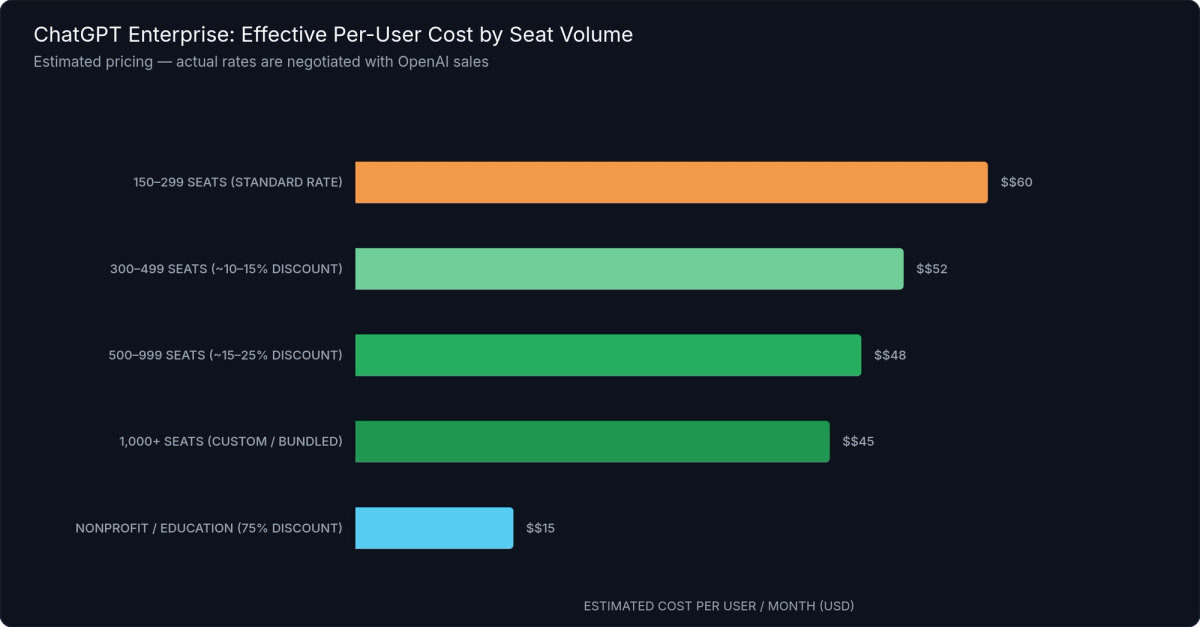
Figure 2: ChatGPT Enterprise Volume Discounts by Seat Count — Estimated effective per-user monthly rate at different deployment sizes
Contract length unlocks additional discounts beyond volume. A two-year or three-year commitment can yield an additional 5–15% reduction compared to a standard one-year annual contract. This matters most for organizations that have already decided on ChatGPT Enterprise and are focused on optimizing the long-term cost.
Usage commitments come into play if your deployment includes developer API usage. If your organization can commit to a minimum token consumption tier — common when developers are building on top of the Enterprise platform — OpenAI can offer blended pricing that reduces the effective per-unit cost across both the seat license and API consumption.
Competitive tension is the most effective negotiation tool available to buyers. Have a real, prepared alternative quote from Microsoft Copilot or Claude Enterprise before entering final negotiations. OpenAI's sales team is aware of the competitive landscape; presenting a credible alternative with a specific number gives your procurement team genuine leverage. A competitor quote that's $10–15/user cheaper is worth more at the table than any amount of internal justification.
Timing matters. Enterprise sales reps are quota-driven, and Q4 and end-of-quarter windows create natural incentives to close deals and offer better terms. If your timeline has flexibility, aligning your contract close to a quarter-end — especially Q4 — is worth scheduling around.
What to Ask For
When you receive your initial quote, these are the specific concessions worth requesting:
- Discounted per-seat rate for volume above your current count if you're near a threshold (e.g., you have 280 seats — ask for 300-seat pricing)
- Pilot/trial cohort seats at no charge — typically 10–25 seats for 60–90 days is achievable before full rollout
- Bundled API credits incorporated into the Enterprise license rather than billed separately
- Annual price increase cap — 2–3% per year is standard; an uncapped renewal rate is a meaningful long-term risk that's often negotiable out
- Professional services or onboarding credits to offset implementation and training costs
- Extended data retention policies included at no extra charge (default retention periods can be short)
The Negotiation Process
Here's how a typical ChatGPT Enterprise deal moves from first contact to signed contract:
- Submit the Contact Sales form at openai.com/chatgpt/enterprise with your realistic seat count and a clear use case description. Vague inquiries get slower responses.
- Sales discovery call (one to two calls) — expect questions about your current tooling, compliance requirements, and decision timeline. Come prepared with your seat count, must-have security requirements, and a realistic budget range.
- Receive the initial quote — treat this as a starting point, not a final offer. It almost never is.
- Counter with volume, term, or competitive justification — use the levers above. If you have a competitive quote, present it here.
- Legal and DPA review — Data Processing Agreement negotiation is standard for Enterprise contracts. Build in 2–4 weeks for enterprise legal teams to review and redline. Security review questionnaires (SIG Lite, CAIQ) are often required by IT security.
Allow 4–8 weeks for a typical Enterprise deal to close from first contact to signed contract. Complex legal requirements or large seat counts can push this to 10–12 weeks.
---
ChatGPT Enterprise Pricing for Nonprofits and Educational Institutions
OpenAI offers a 75% discount on ChatGPT Enterprise for qualifying nonprofits. This is among the largest enterprise software discounts in the market and is dramatically underreported — most competitor pricing guides don't mention it at all.
At 75% off the ~$60 standard rate, nonprofit Enterprise pricing comes to approximately $15 per user per month. The 150-seat minimum still applies, which means the minimum annual cost for a nonprofit drops from ~$108,000 to approximately $27,000 per year. For organizations that previously assumed Enterprise was out of reach, this changes the calculation substantially.
Eligibility
The nonprofit discount program covers:
- Registered 501(c)(3) organizations in the United States
- Equivalent nonprofit legal designations in other countries
- Academic institutions including K-12 schools and higher education (education pricing may differ from the nonprofit rate — see below)
- Healthcare nonprofits and research institutions may also qualify
Organizations that typically do not qualify include political organizations, religious organizations used primarily for advocacy, and government entities. If your organization has a hybrid structure (e.g., a nonprofit arm alongside a for-profit subsidiary), eligibility is assessed at the entity level.
How to Apply
The nonprofit program is processed through TechSoup for US-based nonprofits. TechSoup is the standard verification gateway OpenAI uses to confirm nonprofit status. You'll need:
- Your Employer Identification Number (EIN)
- A current TechSoup token (obtainable through TechSoup's standard verification process, which takes 1–5 business days for organizations already registered)
- An organizational overview and description of intended use case
- Basic contact information for your OpenAI Enterprise account
Verification through OpenAI's side typically takes 1–2 weeks after TechSoup confirmation. Pricing and eligibility terms can change without advance notice; always verify current terms directly with OpenAI's nonprofit sales team before building a budget around this discount.
Education Pricing
Education pricing varies by institution type and is not published publicly:
- K-12 schools typically access discounts through district or state-level agreements; individual school pricing varies significantly
- Higher education institutions receive competitive pricing near or at the nonprofit tier; research universities may negotiate additional API credits
- Contact OpenAI's education team directly at education@openai.com for a tailored quote
---
Total Cost of Ownership: What ChatGPT Enterprise Really Costs
The $60/user/month figure is only the license cost. A realistic total cost of ownership for a 200-seat Enterprise deployment includes several additional categories that procurement teams often undercount in initial budget models.
Implementation and Setup
If your team is deploying ChatGPT Enterprise as a UI-only productivity tool with no custom integrations, setup costs are minimal. IT admin time for SSO configuration and SCIM provisioning typically runs 5–10 hours at initial setup — a one-time cost.
If your deployment includes custom GPT development, API integrations, or Microsoft 365 deep integration, costs rise. Organizations using an implementation partner for full-scale deployment can expect $10,000–$50,000 in professional services, depending on integration complexity. OpenAI's own professional services team can support larger deployments, often as a negotiated add-on to the Enterprise contract.
Training and Change Management
Adoption — not licensing — is the most common reason enterprise AI deployments underperform. Plan for 2–4 hours per user in onboarding and prompt literacy training. At an average knowledge worker cost of ~$50/hour, that translates to $100–200 per user in absorbed time cost. For 200 seats, expect $20,000–$40,000 in change management time.
Formal AI fluency training programs — third-party workshops, internal training development, or e-learning platforms — add an optional $5,000–$25,000 depending on program scope and whether you build internally or purchase externally.
API Costs
If your Enterprise contract includes API access (standard for most Enterprise deals), developer usage is billed separately from the seat license on a consumption basis. A typical developer running active API work might incur $100–500/month in additional API charges. For a team with 20 active developers, budget $24,000–$120,000/year in API costs on top of the seat license — though bundled API credits negotiated into your Enterprise contract can offset this significantly.
Year 1 TCO Estimate — 200 Seats
| Cost Category | Estimate |
|---|---|
| Seat license (200 × $60 × 12) | $144,000 |
| Implementation & SSO setup | $15,000 |
| Training & change management | $30,000 |
| API usage (20 developers) | $24,000 |
| Total Year 1 | ~$213,000 |
At $213,000 for 200 seats, the effective all-in cost is ~$89 per user per month — about 48% higher than the base license rate alone. For a more granular breakdown of Year 1 costs by category, see the chart below.
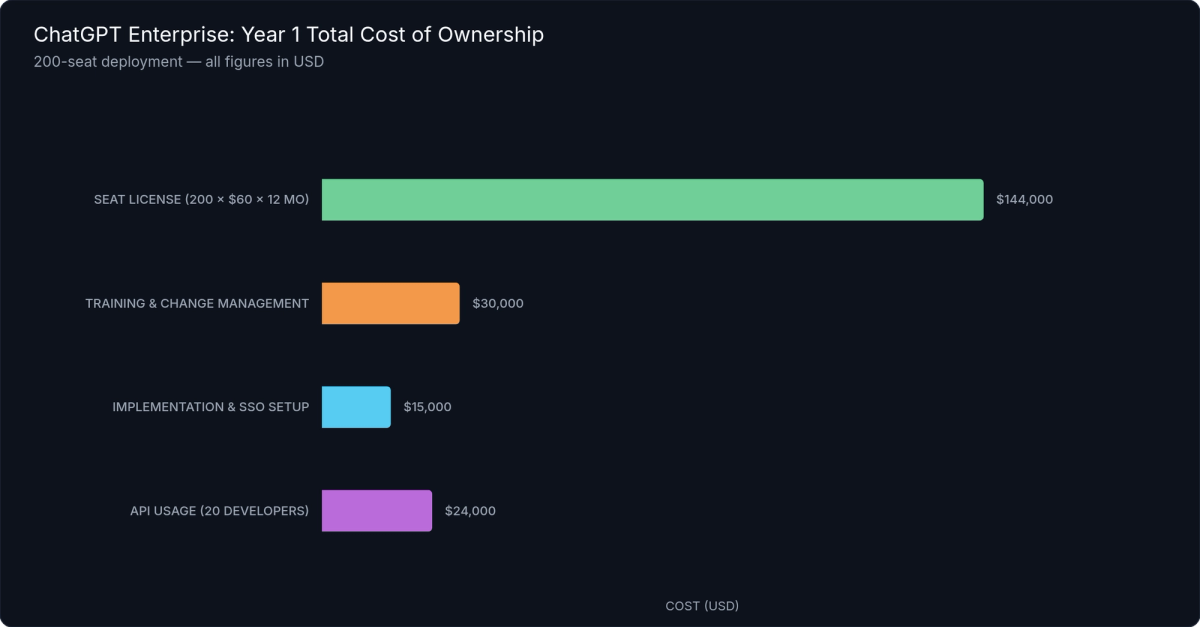
Figure 3: ChatGPT Enterprise Year 1 TCO — 200-Seat Deployment — Total cost of ownership breakdown beyond the base license fee
ROI Framework
The productivity math on enterprise AI is compelling even at conservative estimates. McKinsey and Accenture research on generative AI deployment points to 15–40% productivity gains for knowledge workers on applicable tasks — drafting, research, summarization, code review, and data analysis. Even discounting heavily for uneven adoption, a 10% effective productivity gain is a reasonable floor assumption.
For 200 knowledge workers at an average fully-loaded cost of $80,000/year: a 10% productivity gain is equivalent to $1.6 million in recovered capacity. Against a $213,000 Year 1 TCO, that's a payback period of well under three months at that assumption level.
One caveat: ROI requires real adoption. The primary reason enterprise AI investments underperform, borne out across deployment case studies, is adoption rates below 40–50% active weekly users. Your $213,000 investment earns its ROI only if more than half your licensed users are regularly using the platform. Conservative ROI projections should be tied to realistic adoption targets — not headcount. For a customized ROI projection, see the enterprise AI ROI calculator.
---
ChatGPT Enterprise Pricing: Frequently Asked Questions
How much does ChatGPT Enterprise cost?
ChatGPT Enterprise costs approximately $60 per user per month, though OpenAI does not publish pricing publicly — every contract is negotiated directly with their enterprise sales team. The actual range is roughly $45–$75/user/month depending on seat count, contract length, and volume. With the 150-seat minimum and annual contract requirement, the minimum annual spend is approximately $108,000.
What is the minimum number of seats for ChatGPT Enterprise?
The minimum is 150 seats. ChatGPT Enterprise requires an annual contract with no month-to-month option. Organizations with fewer than 150 users should evaluate the ChatGPT Go plan (new in 2026, ~$35–40/user/month, designed for 10–149 users) or the Team plan ($25/user/month with a two-seat minimum and monthly billing available).
Does ChatGPT Enterprise include GPT-5.4?
Yes. As of March 2026, ChatGPT Enterprise runs on GPT-5.4, OpenAI's current flagship model. GPT-4o was retired in February 2026 and is no longer available on any ChatGPT tier. Enterprise users receive priority access to GPT-5.4, including the full context window and early access to new model updates, typically 2–4 weeks ahead of general availability.
Is ChatGPT Enterprise HIPAA compliant?
Yes. OpenAI offers a HIPAA Business Associate Agreement (BAA) for Enterprise customers, making ChatGPT Enterprise viable for healthcare organizations, insurers, and other covered entities that handle protected health information. The BAA is not automatic — it must be explicitly requested and executed as part of the contract process. Team and lower-tier plans do not include BAA eligibility.
Does OpenAI use Enterprise data for model training?
No. ChatGPT Enterprise does not use customer data to train OpenAI models. This is the contractual default — you are not opting out of training; training use is simply not permitted under Enterprise terms. Conversation data is stored within your tenant only. Audit logs of all user activity are available for compliance and security monitoring.
What is the difference between the ChatGPT Go plan and Enterprise?
The Go plan (new in 2026) is designed for organizations with 10–149 users who need enterprise-grade privacy and SSO without the 150-seat Enterprise floor. It's estimated at ~$35–40/user/month. Enterprise adds HIPAA BAA eligibility, full audit logs, data residency options, dedicated Customer Success Manager support, org-wide custom GPT deployment, and uncapped usage. For organizations above 150 seats with compliance requirements, Enterprise remains the correct choice; below 150 seats, Go offers most of the privacy benefits at a lower cost.
Does OpenAI offer nonprofit or education pricing for Enterprise?
Yes. OpenAI offers up to a 75% discount on ChatGPT Enterprise for qualifying nonprofits (registered 501(c)(3) organizations), bringing the estimated per-seat cost to approximately $15/user/month. Educational institutions also qualify for discounted pricing, with rates varying by institution type. US nonprofits apply through TechSoup for verification; all others can contact OpenAI's enterprise sales team directly. The 150-seat minimum still applies.
---
Conclusion
ChatGPT Enterprise pricing in 2026 starts at approximately $60 per user per month, requires a 150-seat minimum and annual contract, and delivers GPT-5.4 access with no usage caps, enterprise-grade security (SOC 2, HIPAA BAA), SSO/SCIM, audit logs, and org-wide custom GPT deployment. The 2026 product lineup adds the Go plan for mid-market teams below the Enterprise floor and the Frontier platform for organizations moving into agentic AI — both of which change the decision calculus from what existed in 2025. And for nonprofits, the 75% discount program makes Enterprise accessible at roughly $15/user/month, a detail that most buying guides still miss.
Where you go from here depends on where you are in the process.
If you're ready to move forward: Contact OpenAI Enterprise sales at openai.com/chatgpt/enterprise with your real seat count and a clear description of your compliance requirements. Come prepared with a competitive quote and a realistic budget range. Expect 4–8 weeks from first contact to signed contract, and build in time for legal and DPA review.
If you're still evaluating alternatives: Microsoft Copilot is worth pricing out for M365-heavy organizations, and Claude Enterprise deserves consideration if long-document reasoning is your primary use case. Running a side-by-side quote process with at least one competitor also gives you your best negotiation leverage.
If your team is primarily building on AI rather than using a chat interface: The per-seat licensing model may not be the right fit. Direct API access through inference.net provides frontier model access at significantly lower per-token rates, with no seat floor or annual commitment — which makes a material difference for developer-centric organizations building internal tools.
---
References
- OpenAI — ChatGPT Enterprise product page (openai.com/chatgpt/enterprise)
- OpenAI — Security and compliance documentation, SOC 2 Type II, HIPAA BAA availability
- OpenAI — Model deprecation announcements: GPT-4o retirement (February 2026)
- OpenAI — GPT-5.4 launch and release notes (March 2026)
- OpenAI — Frontier platform launch documentation (February 2026)
- TechSoup — OpenAI nonprofit verification and program guidelines
- Microsoft — Microsoft 365 Copilot pricing and feature documentation
- Google — Gemini for Google Workspace pricing and feature documentation
- Anthropic — Claude for Enterprise product and pricing documentation
- McKinsey Global Institute — "The Economic Potential of Generative AI" (generative AI productivity gain estimates)
- Accenture — Enterprise AI deployment and ROI research
- OpenAI community and procurement forums — buyer-reported deal data and negotiation outcomes
- OpenAI education pricing — education@openai.com
Meet with our research team
Schedule a call with our research team to learn more Specialized Language Models can cut costs and improve performance.